
Barbour Projected vs Actual Release
A projected release date is a calculated or scheduled date. It is not the same as the actual release event. For Alabama state prisoners, ADOC's term to teach is Minimum Release Date. ADOC defines it as the earliest scheduled date an inmate can be released to probation or end of sentence. The actual release can be later or different because of discipline, new cases, sentence changes, detainers, parole action, or administrative processing.
County jail cases work differently. The Barbour County Jail current roster does not publish a projected release date or a jail good-time policy. A short county sentence may turn on the sentencing order, jail credit, time served, unpaid case conditions, holds, court schedules, and jail processing. A pretrial detainee does not have an ADOC-style minimum release date because the person has not been sentenced to a prison term.
Scheduled is not final. A Barbour County projected release date must be checked against the jail, court, ADOC, ABPP, or receiving agency before it is treated as actual release.
Find Barbour Projected Release
The first step is to decide which system has custody. Barbour County has the county jail plus two ADOC prisons, Ventress Correctional Facility and Easterling Correctional Facility. A release from one of those state prisons is not a county jail release. The source for the projected date changes with the custody path.
- For a Barbour County Jail detainee, search the current roster first. If listed, ask the jail or court whether a release date, bond action, court order, or hold exists.
- For a sentenced ADOC prisoner, use the ADOC inmate search while the person remains in current custody.
- Read the ADOC fields by agency terms, especially Minimum Release Date, Parole Consideration Date, Jail Credit, Good Time Received, and Good Time Revoked.
- For parole questions, check ABPP scheduled hearings, results, and minutes, then use the Probation & Parole page for supervision confirmation.
- If the person is not found online after ADOC custody, use ADOC Central Records or public records rather than assuming no sentence record exists.
The full Barbour County release-record path on the home page explains how jail, court, DOC, VINE, federal, and ICE channels fit together for a named person.
Barbour ADOC Release Date
ADOC's public search is important for Barbour County because Ventress and Easterling are in the county, and Barbour court cases can send people to ADOC custody. The search fields are AIS number, first name, and last name. ADOC says the AIS number takes precedence, and name searches can return only the first group of matching results when there are many matches. The search is official, but it is not a complete public archive of released former prisoners.
The manifest capture below comes from the ADOC definitions page, which explains the release-date and sentence fields used to interpret Barbour County projected release questions.
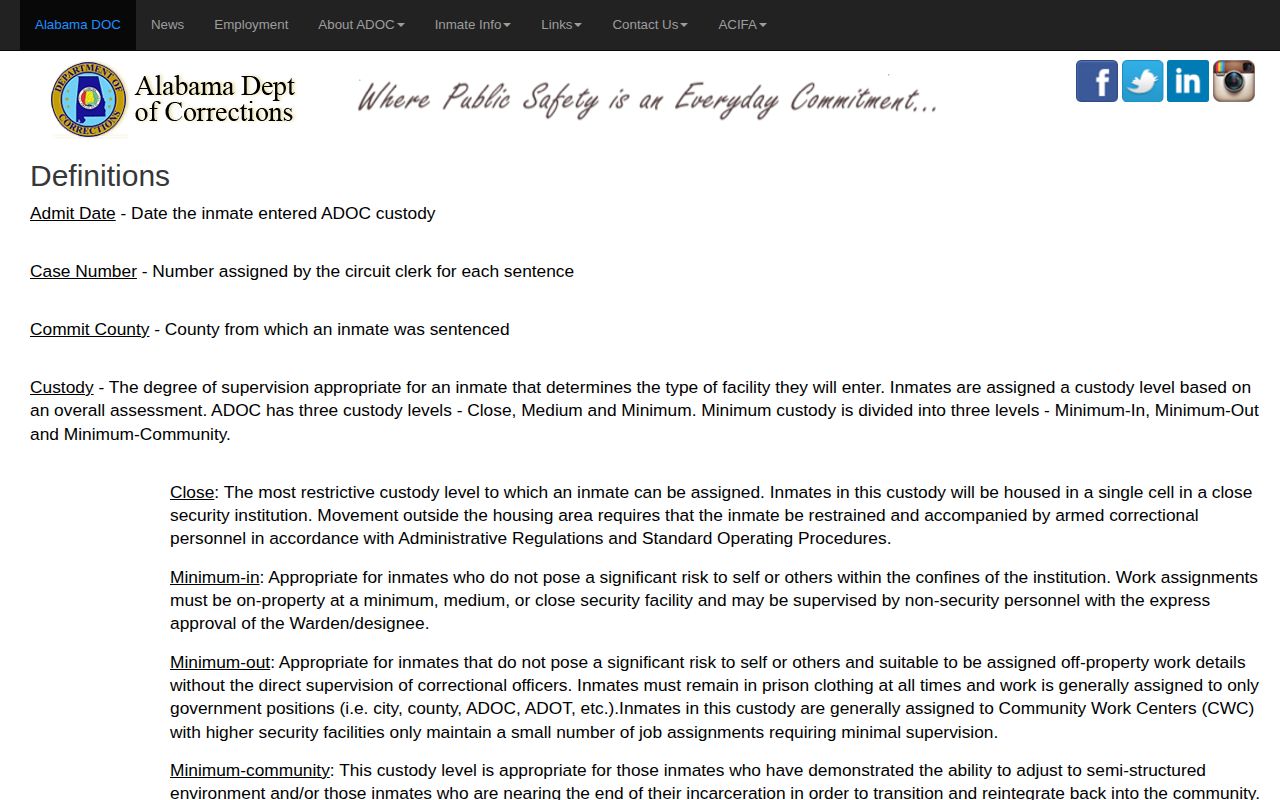
Use that source for terminology. Minimum Release Date is a calculation field. Parole Consideration Date is a tentative board date. Jail Credit comes from the sentencing county's circuit clerk. Good Time Received and Good Time Revoked affect the calculation when the prisoner is eligible.
Barbour Good-Time Rules
Alabama Code Section 14-9-41 governs Correctional Incentive Time for eligible prisoners. The statute sets earning classes. Class I earns 30 days for each 30 days actually served. Class II earns 15 days for each 30 days actually served. Class III earns five days for each 30 days actually served. Class IV earns no correctional incentive time and is often described as flat time or day-for-day.
The same statute has important exclusions and forfeiture rules. A prisoner may be barred from correctional incentive time because of offense type, sentence length, life or death sentence, Class A felony status, a child sex offense, or other listed limits. Serious rule violations can forfeit accrued time or end eligibility. These details are why a projected date can move even after it appears in a sentence record.
Do not import ADOC good-time rules into a Barbour County Jail booking unless the sentence is actually an ADOC sentence. County jail release timing depends on the court order, jail credit, holds, and jail administration unless a state sentence controls the case.
Jail credit is a common Barbour County issue because time spent in county jail before sentencing can affect a later ADOC calculation. ADOC defines Jail Credit as time prepared by the sentencing county's circuit clerk. For Barbour cases, that points back to the Barbour Circuit Clerk offices and the sentencing record. If jail credit appears wrong, the release-date question is not solved by the public inmate search alone. The sentence order, clerk records, and ADOC computation record must be reconciled.
Barbour Parole Date Limits
Parole consideration is not the same thing as a minimum release date. ADOC defines Parole Consideration Date as a tentative date set by the Parole Board. Alabama Code Section 15-22-28 controls initial parole consideration timing. Certain serious Class A felonies committed on or after March 21, 2001 have an 85 percent or 15-year consideration rule, whichever is less. Other prisoners generally fall under the one-third or 10-year rule, whichever is less.
For Barbour County, parole timing matters because a person may leave Ventress, Easterling, or another ADOC facility on parole, then report under ABPP supervision. A parole grant does not mean the sentence record is gone. It means the person is released under supervision unless later revoked, delinquent, or discharged.
ABPP results can also be misread. A reset date is the first month and year when the person can be placed on a future docket. It is not the date of a new hearing and not a promised release date. Special parole conditions are tied to the minutes for the hearing date. When a Barbour County projected release question involves parole, check the scheduled hearing, result, minutes, and local supervision office rather than relying on one date label.
Why Barbour Release Dates Change
Projected release dates move when the underlying sentence data changes. ADOC says minimum release dates can change because of disciplinaries, new cases, or sentence changes from the circuit clerk. Barbour County court action can also affect jail credit, probation, revocation, or sentence correction. Holds and transfers can delay the practical release even after one custody source has ended its part.
| Factor | How It Affects the Date | Where to Verify |
|---|---|---|
| Good-time loss | Discipline can revoke earned time or change eligibility. | ADOC records and definitions. |
| Jail credit | County time before sentencing can affect sentence computation. | Barbour Circuit Clerk and sentencing order. |
| New case or sentence change | New court action can alter the projected date. | Alacourt, clerk, and ADOC records. |
| Parole action | Board grant, denial, reset, or revocation can alter release expectations. | ABPP hearings, results, and minutes. |
| Detainer or hold | Release from one custody source may become transfer to another. | Jail, ADOC, federal, ICE, or receiving agency. |
Confirm Barbour Release Date
Use alerts as support, not as the only proof. VINELink Inmate Search and Alabama VNS can help with custody-status changes when the person is covered by the system. Alabama VNS is especially tied to offenders convicted in Alabama and sentenced to ADOC custody. For a pretrial Barbour County Jail case, the sheriff and court remain primary.
For an official ADOC release or discharge record, ADOC Central Records and public-records procedures are the fallback when the public search stops short. For county jail releases, ask the sheriff or jail records custodian for the release date, time, reason, authority, and transfer destination if any. For court-driven releases, get the case-action summary or order.
ADOC's contact and public-records materials list Central Records and a written public-records process using ADOC Form 23-A under Administrative Regulation No. 23. Requests should be narrow and should identify the person by AIS number if known, full name, date of birth if known, facility, sentence information, and the exact release or sentence-computation record needed. ADOC may require advance fee payment before processing and may redact or withhold restricted information.
Note: A no-result ADOC search can mean the person is not currently incarcerated in the public ADOC database, not that no historical record exists.
Barbour Jail Release Timing
Barbour County Jail release timing is more event-based than formula-based. A pretrial person may leave after bond is posted and processed, after a judge orders release, after a charge is dismissed, after a hold is cleared, or after transfer to another agency. A person serving a short county sentence may leave after time served, sentence completion, jail credit, or a new court order. The public roster does not show a release-date calculation for those events.
For a county-jail projected date, ask the jail whether a release date is set and whether any hold prevents release. Then check the court case for the order that controls the date. If the roster charge line suggests a probation hold or hold for another agency, contact the relevant court, ABPP, or receiving agency. The county jail can confirm when its booking ends, but it may not control the next custody system.
A useful county-jail question is, "what has to happen before release can occur?" The answer may be bond processing, a judge's order, transport to another agency, completion of a short sentence, a clerk correction, or clearance of a hold. That answer points to the source that can confirm the projected date. If the jail says no date is set, the court case may still show the next hearing or order that could change custody.
For Barbour County cases that become ADOC sentences, keep the county and state records together. The county record may show jail credit and sentencing. ADOC records may show the current facility, minimum release date, good-time status, and parole-related fields. ABPP records may then explain parole consideration or supervision. A projected release date is most reliable when those three layers do not conflict.