
Easterling Prison Release Routes
Easterling Correctional Facility is a state prison operated by the Alabama Department of Corrections. It is located in Clio, inside Barbour County, but its release records belong to the state prison system. A person leaving Easterling may be released to parole, probation or other supervision, end-of-sentence discharge, another ADOC facility, a court movement, detainer, or another agency hold. Those outcomes should be verified through ADOC, ABPP, court, notification, or receiving-agency records rather than the Barbour County Jail roster.
This distinction is central in Barbour County. Local search terms often blend county jail releases with releases from Easterling and Ventress, but the record systems are different. The county jail roster answers who is in Barbour County Jail now. ADOC records answer whether a person is in state custody, what release-date fields apply, and how to request records after the person is no longer searchable online.
| Record Need | Easterling Search Route | Why It Matters |
|---|---|---|
| Current custody | ADOC inmate search | Shows current ADOC inmates, not a full historical release archive. |
| Discharge confirmation | ADOC Central Records or public-records request | Needed when a former Easterling prisoner no longer appears online. |
| Parole release | ABPP hearings, results, minutes, and field office records | Parole is supervised release, not a complete end to all obligations. |
| Court sentence details | Alacourt or sentencing court | Confirms conviction, sentence, jail credit, and orders that affect custody. |
Verify an Easterling Release
The first step is to decide whether the person may still be in ADOC custody. ADOC's public search uses AIS number, first name, and last name. The research found that the AIS number controls the search when entered. Name searches are open-ended and can return many results, so identity should be checked against multiple fields. If the person has already been discharged, the public search may not show them because ADOC says historical data is not available online at this time.
- Search ADOC by AIS number when available. If not, search by name and compare results carefully.
- If the person appears, note the facility, sentence information, minimum release date, parole status, and related fields shown by ADOC.
- If the person does not appear but was known to be at Easterling, request release or discharge records from ADOC.
- Check ABPP current-year parole results and hearing minutes if parole may be involved.
- Use Alabama VNS or VINELink Inmate Search as notification and custody-change tools, then confirm with the source agency.
- Check Alacourt or the sentencing court for sentence, jail credit, and disposition records.
Easterling ADOC Facility Page
The official facility source is the ADOC Easterling Correctional Facility page, which identifies Easterling as an ADOC prison in Barbour County.
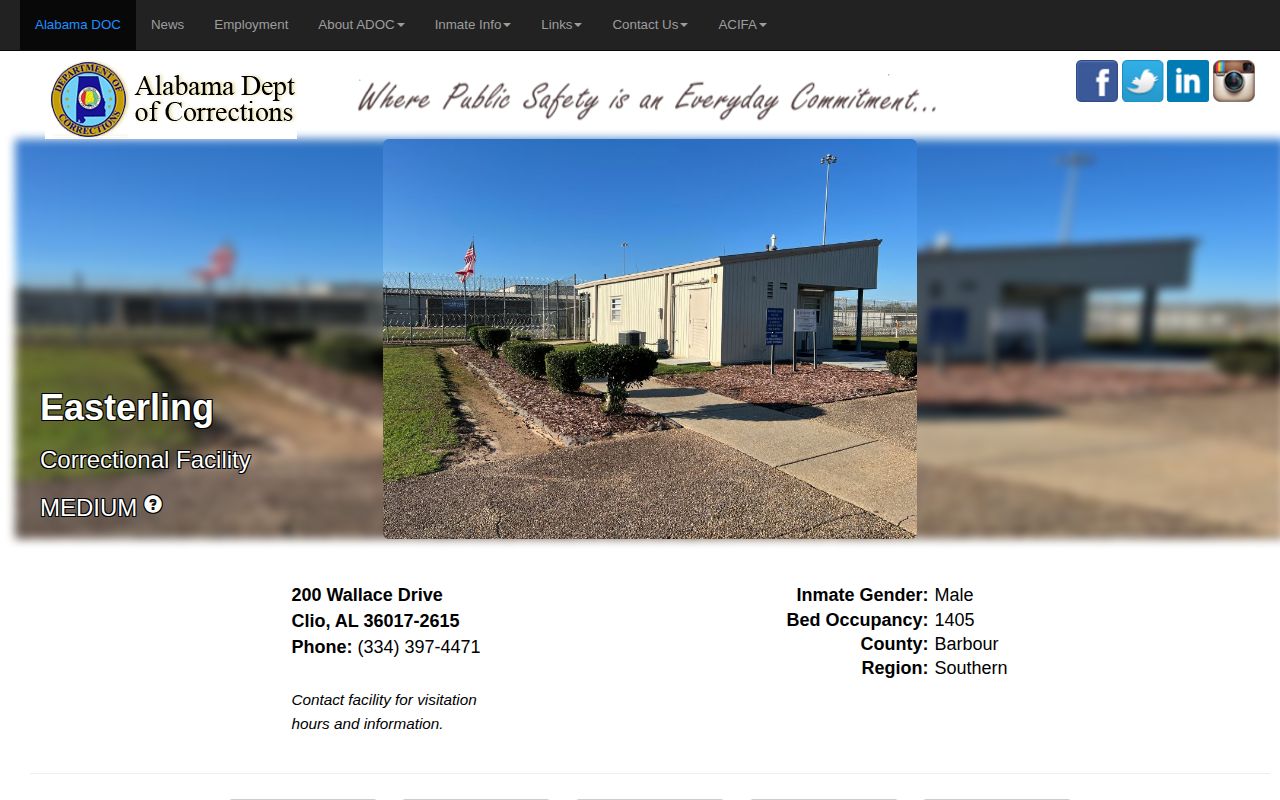
The facility page anchors the local details, but it does not replace the release-record process. A release from Easterling should be matched to ADOC status, a discharge or transfer record, parole results when relevant, and the sentencing court record. For a released person, those sources are stronger than a county jail roster search.
Easterling Records and Contact
Easterling's facility contact can help identify the institution, but ADOC records channels are the better route for release or discharge records. ADOC lists Central Records, a public-records coordinator, Form 23-A, and its public-records policy on the agency contact page. A request should ask for a specific state-prison record, not a broad search. Include the person's name, AIS number if known, Easterling facility reference, sentence date or county if known, and the release or discharge fields needed.
Easterling Correctional Facility
200 Wallace Drive
Clio, AL 36017-2615
334-397-4471
Operating agency: Alabama Department of Corrections
ADOC Central Records
301 S. Ripley Street
P.O. Box 301501
Montgomery, AL 36130-1501
334-353-9738
ADOC public records policy
public.records@doc.alabama.gov
When the release was tied to parole, use ABPP records as well. When the release-date calculation turns on jail credit or sentence correction, the sentencing court can be decisive. For Barbour County cases, the Barbour Circuit Clerk has offices and phone routes in Clayton and Eufaula, and Alacourt provides paid online trial-court access.
About Easterling Prison
ADOC lists Easterling as a medium-custody male facility in Barbour County. The facility page gives the address at 200 Wallace Drive in Clio, notes a March 1990 opening, and describes a site on 200 acres on Alabama Highway 10 East. The research also found drug treatment counseling and vocational or educational programs through Wallace Community College, including drafting, industrial electricity, cabinet making, plumbing, and brick masonry.
Those facility facts help separate Easterling from the county jail. A person housed there is serving or awaiting movement under a state-prison record. Release confirmation follows ADOC and ABPP paths first, then the court and any receiving agency when transfer or detainer issues appear.
Easterling Release-Date Fields
ADOC's release-date vocabulary matters for Easterling searches. The key term is Minimum Release Date. ADOC defines it as the earliest scheduled date an inmate can be released to probation or end of sentence, and the date can change. Discipline, loss of good time, new cases, or sentence changes sent by the circuit clerk can move the calculation. Parole Consideration Date is different. It is a tentative date set by the Parole Board, not the same thing as the minimum release date.
| Minimum Release Date | Earliest scheduled release to probation or end of sentence, subject to ADOC calculation changes. |
|---|---|
| Good Time Received | Credit earned under Alabama Correctional Incentive Time rules when eligible. |
| Good Time Revoked | Credit lost after discipline or other rule violations. |
| Jail Credit | Pre-sentence county jail time prepared by the sentencing circuit clerk. |
| Parole Status | Whether parole is active, delinquent, revoked, or otherwise reflected in ADOC data. |
Alabama Code Section 14-9-41 governs Correctional Incentive Time. Section 15-22-28 governs parole consideration timing. The court record remains important because sentence changes and jail credit come from the court side, not from the facility page alone.
Barbour County ADOC Context
Barbour County has two ADOC state prisons, Easterling in Clio and Ventress in Clayton. That makes the county different from places where released-inmate searches focus almost entirely on a sheriff's jail. Easterling opened in March 1990 on a large site and has treatment and vocational programming. Ventress opened in August 1990 and has a treatment mission. Both facts support a local state-prison angle, but neither turns an ADOC discharge into a county jail release.
For a Barbour County released inmate search, the first split is custody type. If the person was in Barbour County Jail, use the sheriff, court, VINE, and receiving-agency route. If the person was in Easterling or Ventress, use ADOC, ABPP, Alabama VNS, VINELink, and the sentencing court. That one split prevents many false negatives and false assumptions.
Easterling Notifications and Registries
Alabama VNS and VINELink can help with custody-change notices for eligible Alabama offenders. The state VNS page says it is for offenders convicted in Alabama and sentenced to prison, which fits ADOC custody. For pretrial county cases, the state VNS page points users back to the sheriff in the county where the crime occurred. For Easterling, VNS and VINE are useful, but they should be checked against ADOC records and court records for exact release dates and reasons.
The ALEA sex offender registry may also become relevant for a limited group of released people after conviction and release. ALEA says local law enforcement submits registration information, current photographs, and fingerprints, and that not all offenders are publicly disseminated because of juvenile, Youthful Offender, or out-of-state limits. Registry information is not a general Easterling release list. It is a separate legal status channel for qualifying registrants.
Note: Notification and registry systems can support release research, but ADOC and court records remain the core source for a state-prison discharge.
Easterling Transfer Questions
An Easterling release can be a transfer instead of a return to the community. Court writs, detainers, other agency holds, or movement to another ADOC facility can all change where the person goes next. If the receiving system is federal, use the BOP locator and federal court records. If immigration custody is indicated, use ICE's locator for current ICE custody or CBP custody over 48 hours. If the movement is within ADOC, ADOC records remain the first source.
Historical TRAC data found for Barbour County Jail should be kept in its lane. It supports the local point that a county-jail release can become a detainer or transfer issue, but it does not prove a current ICE contract or an Easterling ICE release feed. For any transfer, confirm the source facility, release type, and receiving agency.