
Barbour County Parole vs Probation
Parole and probation both affect a released Barbour County person, but they start from different records. Parole usually follows an Alabama Department of Corrections prison sentence. The Alabama Board of Pardons and Paroles may grant release from prison under supervision, and the person must follow parole conditions until the term ends, is revoked, or is discharged. Probation usually comes from the sentencing court. A judge may place a person on probation, impose a split sentence, revoke probation, or end probation through a court order.
The distinction matters because the Barbour County Sheriff's current inmate roster is not a supervision lookup. The roster can show why someone is in jail now, including local charge lines such as probation violation or probation hold. It does not show the full supervision file, parole conditions, hearing minutes, or discharge record. For a named person, the stronger path is to pair the court case with Alabama Bureau of Pardons and Paroles records and the local field office serving Barbour County.
| Record Type | What It Means | Where to Verify |
|---|---|---|
| Parole | Release from ADOC custody under board supervision, not an unconditional discharge. | Alabama Bureau of Pardons and Paroles, hearing results, minutes, and field office. |
| Probation | Court-ordered supervision in a criminal case, often tied to sentencing or a split sentence. | Alacourt ACCESS, Barbour Circuit Clerk records, and ABPP field office. |
| Discharge | The supervision term has ended or the sentence has otherwise been completed. | Court order, ABPP public records, or ADOC records depending on the sentence. |
- Absconder
- A supervised person reported as not complying with required contact or location rules.
- Revocation
- A court or board action that can return a person to custody after a violation.
- Reset date
- A parole-results term for future docket placement, not a new release date.
Verify Barbour County Supervision
A supervision check works best when the custody source is separated from the court source. Barbour County Jail may confirm a booking or release event, but probation and parole status comes from court orders, ABPP records, and state supervision contacts. If the person was sentenced to ADOC, also check ADOC records and parole hearing material. If the case was handled in county court, look for probation orders, revocation orders, sentence orders, or case-action summaries.
- Start with the court case. Use Alacourt ACCESS or the Barbour Circuit Clerk to find probation, split sentence, revocation, bond, or discharge orders.
- For ADOC-sentenced parole, review scheduled parole hearings, current-year results, prior-year results, and linked hearing minutes.
- Use the ABPP Clayton Field Office if the person reports in Barbour County or Bullock County, or if the public record points to that local office.
- Submit an ABPP public-records request when a formal parole or supervision document is needed. ABPP lists public.records@paroles.alabama.gov for request forms.
- Use VINELink Inmate Search or Alabama VNS as a custody-change alert, then cross-check with the source agency.
For a broader release path, the Barbour County released-inmate search on the home page explains when to use the sheriff, ADOC, court, VINE, federal, or ICE channels. Supervision is only one part of that path.
When the court record is the starting point, look for the order that created the supervision duty. Common Barbour County documents include a probation order, split sentence order, revocation order, sentencing order, case-action summary, or certified disposition. Alacourt can help locate the case, but the clerk's offices may still be needed when the case division, municipal source, or older record is unclear. A jail release record may show that custody ended; the court and ABPP records explain whether supervision followed.
Barbour County ABPP Office
The local adult supervision contact is the Alabama Bureau of Pardons and Paroles Clayton Field Office. The office serves Barbour and Bullock counties, which gives Barbour County supervision research a concrete local record point rather than a statewide-only explanation. It is the place to route purpose-neutral questions about how public supervision status can be verified and what agency record may confirm it.
ABPP Clayton Field Office
2 North Midway Street
Clayton, AL 36016
Mailing address: PO Box 441, Clayton, AL 36016
Phone: 334-775-8712
Fax: 334-775-7265
Hours: Monday-Friday, 8:00 a.m.-5:00 p.m.; closed state and federal holidays
The Barbour court directory also lists Pardon and Parole contacts for Eufaula at 334-688-1745 and Clayton at 334-775-8712. That two-location detail matters because Barbour County court and agency contacts can be split between Clayton and Eufaula. Match the office to the case, the sentence, and the person reporting under supervision.
The source page for the Clayton Field Office is shown below from the manifest capture. It is the best matching image for the Barbour County parole and probation page.
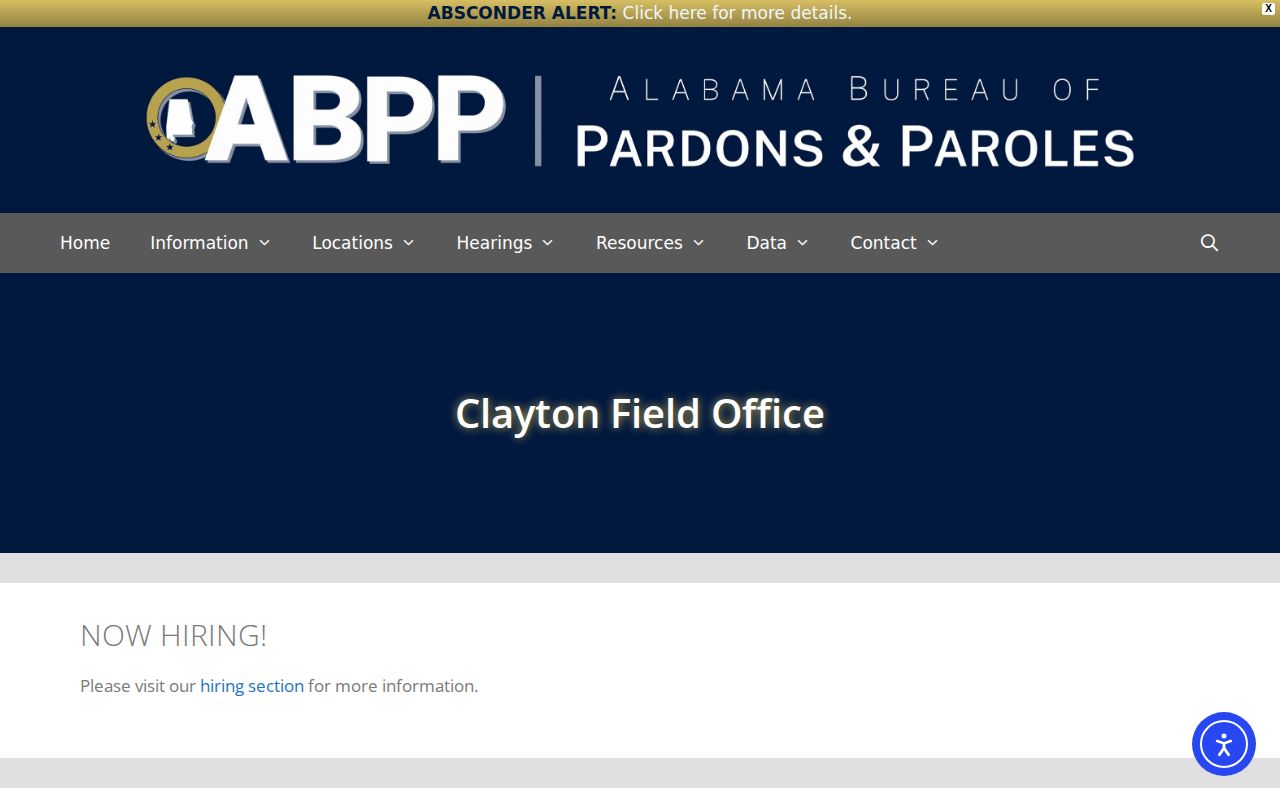
The office details should be read as routing information. They do not replace the court order, parole result, supervision file, or jail release record.
Barbour County Parole Results
ABPP hearing records help explain whether an ADOC-sentenced person was considered for parole, granted parole, denied, continued, reset, rescinded, or subject to other board action. The agency's public site links scheduled hearings, cancellations, current-year parole results, prior-year results, hearing minutes, public records, field offices, and absconder alerts. Use those pages for parole history before treating a prison release as final discharge.
The results page has a key interpretation point for Barbour County parole and probation research. A reset date means the first month and year when a person may be placed on a future docket. It is not the date of a new hearing and not a projected release date. Special conditions are found in the minutes for the hearing date. That difference prevents a common mistake when checking whether someone released from ADOC is under supervision in Barbour County.
Parole eligibility is controlled by Alabama Code Section 15-22-28. The statute requires board action for parole release and sets timing rules, including special treatment for listed serious Class A felonies and general timing based on one-third of the sentence or 10 years for other prisoners.
Barbour County Absconder Checks
An absconder alert is a post-release supervision status. It is not the same thing as a Barbour County Jail release, and it is not proof that the person is currently in the county jail. ABPP's absconder alerts tell the public to contact local law enforcement immediately if they have information and to contact the agency or local law enforcement for more information. Treat the alert as a supervision record that must be linked back to the court or parole file.
Violations can affect custody and release records in several ways. A probation violation may create a jail booking. A parole violation may lead to revocation proceedings or a return to ADOC custody. A hold can keep someone in jail even after another charge is resolved. If the Barbour roster shows a probation hold or violation charge line, do not assume the final supervision outcome. Check the case action, ABPP status, jail release record, and any receiving-agency record.
Note: A released person can be off the jail roster and still have open supervision obligations through ABPP or a court order.
Barbour County Reentry Context
Barbour County is unusual because it has two ADOC prisons inside the county: Ventress Correctional Facility in Clayton and Easterling Correctional Facility in Clio. That means many local release questions are state-prison questions, not just county-jail questions. Ventress and Easterling both publish ADOC program details, including treatment, education, or vocational context. Those details do not prove what any named person received, but they explain why ADOC records, ABPP supervision, and state notification systems matter in Barbour County.
A person released from Ventress or Easterling is not a Barbour County Jail release just because the prison is in Barbour County. Use ADOC, ABPP, Alabama VNS, court sentence records, and the parole results pages. Use the Barbour jail only if the person separately entered county custody.
Barbour County Supervision Discharge
Supervision ends through discharge, sentence completion, a court order, board action, or another controlling record. A parole grant is not discharge. Probation is not the same as release from jail. The final proof is usually a court order, ABPP record, ADOC record, or case action summary that shows the status changed. Alabama public-records law allows requests for public records subject to fees and exemptions, but sensitive, sealed, juvenile, Youthful Offender, medical, or confidential supervision details may be withheld.
For a Barbour County probation discharge, ask for the court order or case-action summary. For an ADOC parole discharge, ask ABPP what public record confirms the status. For a release from jail with no supervision, the sheriff's release record and court disposition are usually the main sources. These record paths keep "released from custody" separate from "released from supervision."